Sagging ceiling repairs in Newcastle
A sagging ceiling is a safety problem before it is a cosmetic one, and it gives you warning before it comes down. We look at sagging ceilings right across the Hunter and the Central Coast, from photographs first and on the phone second. Send photographs of the ceiling. We work out with you on the phone whether it can be refixed or whether the lining has to be replaced. We supply the board, the compounds and the cornice, and we leave the ceiling set and ready for your painter.
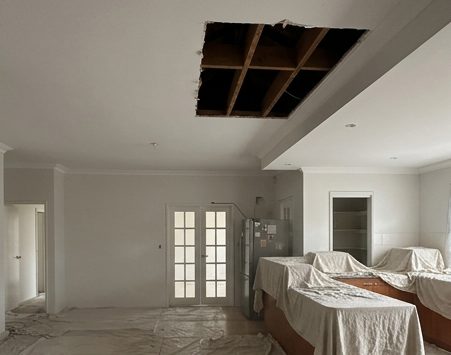
Sheeting a ceiling that has to be replaced
We sheet the ceiling again and set it. Where the lining goes back rather than gets refixed, we supply board to suit the joist or batten spacing that is up there. We fix it to the schedule, back block the butt joints and set the ceiling to a Level 4 finish. We make the cornice line good where the sag has opened it along the wall.
- Board grade matched to the real batten spacing
- Butt joints back blocked
- Cornice line made good where the sag opened it
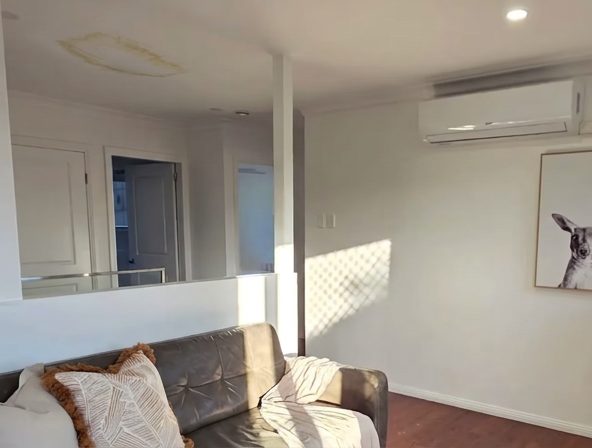
Ceilings flagged at a rental inspection
We quote sagging ceilings for property managers and agencies from inspection photographs. A ceiling flagged on a Tuesday gets an answer rather than an appointment. Send the photographs from the condition report. We come back with what we think it is, what the options are and what each one costs. Where a ceiling looks unsafe we will say so on the phone rather than in a quote.
- Quoted from the inspection photographs
- An answer with the options and what each one costs
- Options and costs set out to pass to the owner
Why ceilings sag
A plasterboard ceiling rarely fails without warning, and the cause is usually one of a short list. Most of them were decided years earlier, on the day the ceiling went up. These are what we are looking for when you send a photograph.
Ceilings warn you before they come down
There are three signs. A sag between the joists, cracking along a joint line, and small circles or blisters where the sheeting is pulling away from the fasteners. Any of the three is worth a phone call rather than a wait and see. A ceiling that lets go can hurt whoever is under it. Send us a photograph the day you notice any of the three.
There was never enough adhesive up there
The daub of adhesive holding a sheet flat against a ceiling joist is specified at 25mm across and 15mm high, at 230mm centres. The WA Building Commission reviewed plasterboard ceiling failures. It found insufficient adhesive in a large share of the placements, in every failure it looked at. The daubs disappear the moment the sheet goes up, so nobody sees the shortfall until the ceiling starts to drop years later.
Adhesive was never allowed to be the fixing system
CSR states plainly that stud adhesive is not a fixing system by itself and must be paired with mechanical fixings. A ceiling screwed only at the sheet edges and glued through the middle was always relying on the glue outlasting the house. Where a ceiling has come loose in the field but the board itself is sound, that is usually what has happened.
The board may be spanning further than it is rated for
Every sheet carries a maximum spacing, and for Gyprock Plus at 10mm that number is 450mm. Trusses and battens commonly run at 600mm, where the board has to be Supaceil or 13mm. Thin board across a wide span sags on its own schedule no matter how well it was fixed. No amount of refixing shortens the span. Where that is the cause, the grade that goes back has to suit the spacing that is up there.
Insulation the ceiling was never designed to carry
The span tables that set the board grade and the framing centres assume an insulation load of 5kg/m² at most. Retrofit batts laid over a ceiling built for less put it outside what it was designed for. So do batts that have taken water and held it. This is one of the few causes a homeowner can create years after the house was finished. It is worth knowing about before more goes up there.
Wet board gets replaced, not screwed back up
CSR's position is that plasterboard is replaced after it has been substantially wet, because board strength and the holding capacity of fixings may be reduced. Anything less than that still has to dry right out and then be looked over for warping before it goes back up. A ceiling a roof leak has run through is a replacement question rather than a refixing one.
Putting the ceiling back without fixing the cause buys a year
The recorded causes of ceiling collapse are storm damage, water leaks, inappropriate access to the roof space, inappropriate materials and poor workmanship. Four of those five sit outside the ceiling itself. A ceiling put back under a roof that still leaks, or under a cavity people keep walking through, comes back. We will say when the roof or the leak has to come first.
An older Newcastle ceiling is a different question
Australia did not see paper faced plasterboard until 1947, and it stayed uncommon here into the 1960s. A ceiling in Cooks Hill, Hamilton or Carrington may not be plasterboard at all. Older ceilings are held up in ways plasterboard is not, and any pre 1990 sheet lining is an asbestos question before it is a repair. We look at these case by case from a photograph rather than treating them as the same job.
How we handle a sagging ceiling
We look at your photographs first
Send photographs of the ceiling taken from a few metres back rather than up close. One along the ceiling line so the sag shows against the wall. A photograph is how we tell a plasterboard ceiling from an older one, and that changes the whole job. Quoting is free.
We decide the repair with you on the phone
There is no single answer to a sagging ceiling, so we work it out with you rather than quoting a method sight unseen. The age of the house and the size of the sag both move the answer. So does whether water has been through it, and what is sitting on top of the ceiling. You get told what we think it is and what each option involves.
We supply the board and the cornice
The plasterboard, the compounds, the cornice and the fixings come from us. Ceiling board is chosen by the spacing it has to span rather than by what is cheapest on the rack. The grade going back up is the grade the framing calls for. The ceiling goes back set and sanded, and your painter takes it from there.
Get a free quote
Send one photograph from a few metres back so the sag shows against the wall line, and one along the length of the ceiling. Add one of any crack or blistering. Tell us roughly when the house was built and whether water has ever been through the ceiling. Quotes are free and travel is not charged anywhere we work. Quotes are free, including a site visit where one helps, and we do not charge for travel.
Brands we supply and install
Newcastle Gyprocker Heroes supply the board, the cornice, the compounds and the fixings on every job, so there is nothing for you to order and no delivery to wait on. That is worth saying plainly: if you have already bought your own sheets, you are looking for a different arrangement to the one we offer.
Service available across every Newcastle region
City of Newcastle
Newcastle CBD, Newcastle East, The Hill, Cooks Hill, Merewether, Bar Beach, The Junction, Hamilton, Islington, Wickham, Carrington, Tighes Hill, Mayfield, Waratah, Georgetown, Lambton, New Lambton, Adamstown, Broadmeadow, Jesmond, Wallsend, Maryland and Fletcher
Lake Macquarie
Charlestown, Kotara, Warners Bay, Speers Point, Boolaroo, Cardiff, Edgeworth, Glendale, Cameron Park, Belmont, Valentine, Eleebana, Redhead, Dudley, Swansea, Caves Beach, Toronto and Morisset
Maitland and the Hunter Valley
Maitland, East Maitland, Rutherford, Lorn, Bolwarra, Thornton, Beresfield, Chisholm, Gillieston Heights, Lochinvar, Farley, Branxton, Greta, Cessnock, Kurri Kurri, Weston and Singleton
Port Stephens
Raymond Terrace, Heatherbrae, Medowie, Williamtown, Fern Bay, Tomago, Salt Ash, Tanilba Bay, Lemon Tree Passage, Salamander Bay, Corlette, Soldiers Point, Nelson Bay, Shoal Bay and Anna Bay
Central Coast
Gosford, East Gosford, West Gosford, Erina, Woy Woy, Umina Beach, Ettalong Beach, Kincumber, Avoca Beach, Copacabana, MacMasters Beach, Terrigal, Wyoming, Wyong, Tuggerah, Watanobbi, Berkeley Vale, Bateau Bay, Long Jetty, The Entrance, Toukley, Budgewoi, San Remo and Lake Munmorah
Frequently asked questions
Is a sagging ceiling dangerous?
Yes. A ceiling collapse can cause serious injury to anyone in the room at the time. Newcastle Gyprocker Heroes treat a sagging ceiling as a safety problem rather than a cosmetic one. The warning signs are a sag between the joists and cracking along a joint line. The third is small circles or blisters where the sheeting is pulling away from the fasteners. Send a photograph the day you notice any of them.
What decides whether a sagging ceiling is refixed or replaced?
The cause decides it, and we work it out with you on the phone. Newcastle Gyprocker Heroes look at your photographs first. Then we talk through the age of the house, the size of the sag, and whether water has been through the ceiling. Board that has been substantially wet is replaced rather than refixed.
Why is my ceiling sagging between the beams?
Three causes account for most of it. The first is a sheet asked to span further than its rating. 10mm Gyprock Plus is limited to 450mm ceiling centres, and trusses often run at 600mm. There may never have been enough adhesive behind it. Or insulation added later has taken the ceiling past the 5kg/m² load its span tables assume.
How much does a sagging ceiling repair cost?
Sagging ceilings are quoted per job rather than at a set rate. A refix and a replacement are different pieces of work and the photograph decides which one your ceiling needs. Send photographs to Newcastle Gyprocker Heroes and we give you a figure and talk it through on the phone. There is no charge for the quote and no travel charge added on top of the job.
What do you need from me to quote a sagging ceiling?
Photographs and a phone call. Stand back a few metres for the first, shoot along the ceiling for the second, and get close on any crack for the third. Tell us roughly when the house was built and whether water has ever come through. Newcastle Gyprocker Heroes price the work from that.
Do you repair older ceilings that are not plasterboard?
Yes, case by case. Newcastle Gyprocker Heroes look at an older ceiling from a photograph first. A ceiling from before the 1960s is often not plasterboard and is not held up the same way. Any pre 1990 sheet lining is an asbestos question before it is a repair, and we do no asbestos work of any kind.
Do you put the cornice back where the ceiling has dropped?
Yes. Where a ceiling sags, the cornice line usually opens along the wall, and we make it good as part of the work. We supply the cornice. Where a full run has to be replaced rather than reset, we tell you before we start rather than after. It is in the figure you agreed to.
Ready to get a price?
Send plans or photographs and we will price the job. Quoting is free and so is the travel.