New home plasterboard supply and install in Newcastle
We sheet new homes for builders and owner builders right across the Hunter and the Central Coast. Send us your floor plans and we measure the job off them. We work out the sheet lengths room by room and give you a fixed price per square metre. We supply everything: the plasterboard, the cornice, the compounds and the fixings, delivered to site. You get walls and ceilings set, sanded and ready for your painter to prime.
Wet area sheeting
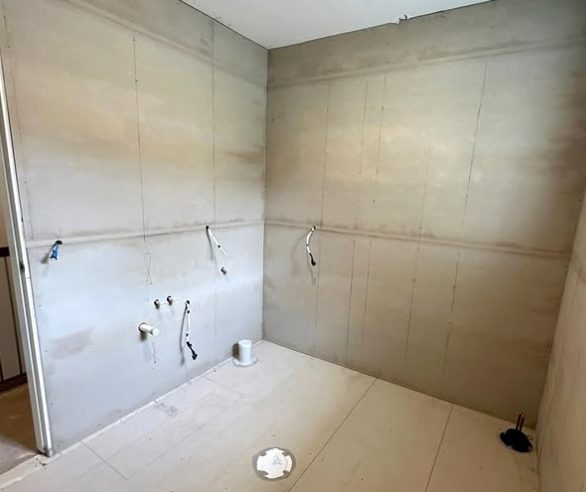
We sheet the bathrooms, ensuites and laundries, and we fix them differently from the rest of the house. We use water resistant board to AS/NZS 2588. We tighten the fixing centres from 400mm to 200mm under tiles up to 12.5kg/m², and to 100mm under anything heavier. We use no stud adhesive at all in a tiled wet area, because the system does not permit it. Then a boundary worth stating plainly, because it decides what happens next on your programme: water resistant board is not a waterproof membrane. The membrane is a separate system laid over our work, and until it is on, nothing in that room is sealed. We leave the walls set and sanded, and the membrane and the tiling are your waterproofer's.
- Water resistant board to AS/NZS 2588
- Fixings at 200mm under tiles, 100mm under heavy tile
- No stud adhesive anywhere in a tiled wet area
- Set and sanded ready for the waterproofer
Garages, granny flats and secondary dwellings
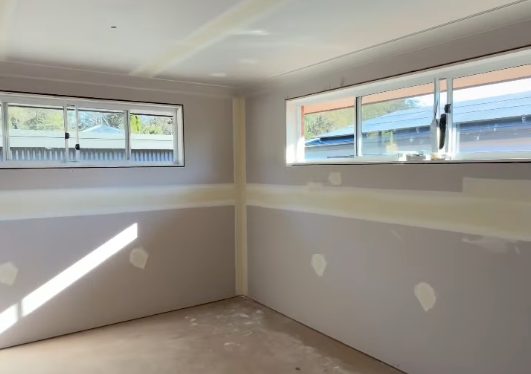
We quote these as their own scope rather than folding them into the house, because they usually sit as a separate line on your programme. We treat a secondary dwelling as a small house: habitable rooms at 2400mm, wet areas, cornice. The same Level 4 finish we run through the main build. A garage is a different thing, and on the narrow lots through the Hunter estates it is also where the boundary wall turns up. We sheet a boundary or separating wall to the system your certifier or engineer has specified. That means the board, the screws and the spacings the system calls for. We do not specify it and we do not certify it.
- Quoted as its own scope from the same plans
- Wet areas, cornice and Level 4 through a secondary dwelling
- Boundary and separating walls sheeted to your specified system
What goes wrong on a new build
Most plasterboard problems in a new house are decided long before anyone picks up a sheet. These are the eight that come up across the Hunter. Nearly all of them are cheaper to design out at take off than to chase after handover.
The wrong ceiling board for the batten spacing
10mm Gyprock Plus is rated to 450mm ceiling centres. Most trusses and battens run at 600. Put the wrong sheet up and it sags between the battens, slowly. It shows up as a wavy ceiling under a light rather than as a failure. At 600 centres the board has to be Supaceil or 13mm. We know which one your house needs before the order goes in because we have your plans.
Butt joints that were never planned
Where two sheet ends meet away from a stud or a joist, the joint has to be back blocked. A 200mm strip of board is bedded behind it with back blocking cement, spread with a 6mm notched trowel across the joint. The joint is pressed in to form a recess for the compound to sit in. AS/NZS 2589 requires it and manufacturer warranties on the board can be void without it. Ordering the right sheet lengths at take off removes most of those joints from the house.
Stud adhesive treated as a fixing
Adhesive holds a sheet flat against the frame. It is not what holds it up. CSR's own instruction is that stud adhesive does not constitute a fixing system on its own and has to be used with screws or nails. Daubs go on 25mm across and 15mm high, at 300mm centres on walls and 230mm on ceilings, never where a screw is going. The sheet has to be on the frame within 20 minutes of the daubs being laid. It is not permitted at all on tiled wet area walls or in fire rated systems.
The wrong screw for what it goes into
A screw is chosen by the substrate, not by the box it came out of. Softwood pine framing takes a #6 Type W. Hardwood takes a #6 Type S needle point, and so does light steel up to 0.8mm. Steel above that needs a drill point. Get it wrong and the screw strips, or it dimples the stud flange and pulls the sheet out of line. It matters most on a knockdown rebuild in Merewether or Mayfield. There the retained frame is hardwood, and the screw that worked all week on pine will not bite.
Wet areas fixed like dry ones
In a bathroom or a laundry the fixing pattern tightens. Field fixings go from 400mm to 200mm under tiles up to 12.5kg/m², and to 100mm under heavier tiles. Stud adhesive is not permitted anywhere in the system. Water resistant board is also not a waterproof membrane. AS 3740 requires a separate membrane over the board and into the junctions before anything is tiled, to 1800mm above the floor in a shower. The board is the substrate, not the waterproofing.
A frame that stood through a wet week
The window between frame up and lock up is a real risk here. In May 2025 an East Coast Low put around 300mm of rain across the region in under 24 hours. The disaster declaration covered Newcastle, Lake Macquarie, Maitland, Cessnock and Port Stephens. A frame that has been rained on is a frame that is still drying, and adhesive bond may be unsatisfactory on wet or unseasoned timber. It is a reason to check the frame before sheeting rather than to sheet the week the roof goes on.
Ground movement in a mine subsidence area
A new house going up at Newcastle, Lake Macquarie, Maitland West, East Maitland, Branxton or Greta may be inside a Mine Subsidence District. It is designed to move. Its masonry is articulated and its footings are detailed for it. The lining has to be able to move too, which is what control joints are for. The maximums are 12m on a normal internal wall, 4.8m on a tiled wall and 6m on an external ceiling. Those maximums come from the standard rather than from preference. On a site expected to move they are worth setting out across the whole house rather than deciding wall by wall.
Critical light after the downlights go in
A wall that looked flat during the build can show every joint once the downlights and the window coverings are in. That is glancing light, and it is the most common argument on a finished house. Level 4 is not built to defeat it. Level 5 adds a skim coat over every square metre and is what you specify when it matters. Even then the manufacturer's own guidance stops short of promising the light will stop finding things. The decision belongs at frame stage, not at painting.
What a supply and install package covers
Take off from your plans
We measure the whole house off your drawings and work out how many sheets it takes and what lengths they should be. Choosing the right lengths designs most of the butt joints out of the house before anything is ordered. Board runs from 2400mm to 6000mm in 300mm steps, so most rooms can be covered by a single sheet across.
We supply and deliver the materials
Sheets, cornice, compounds, tape and fixings all come from us and arrive on site with the job. You are not ordering board, chasing a delivery or storing pallets. It also means the board that turns up suits your frame. That matters more than it sounds. A ceiling battened at 600mm needs a different sheet from one at 450mm.
Three coats, set and sanded
We tape the joints, run two more coats over them, and cover every fastener head. Each coat is a setting compound that goes off chemically in about an hour. We work through the coats in a day rather than across a week. Then we sand the whole lot back. That is a Level 4 finish, which is the standard for a house.
Get a free quote
Send us your floor plans and we will price the job off them. Most new home quotes need no site visit at all. A plan gives us the wall and ceiling areas, the ceiling heights and the room layout. If a site visit helps, it is free. Quotes are free, including a site visit where one helps, and we do not charge for travel.
Brands we supply and install
Newcastle Gyprocker Heroes supply the board, the cornice, the compounds and the fixings on every job, so there is nothing for you to order and no delivery to wait on. That is worth saying plainly: if you have already bought your own sheets, you are looking for a different arrangement to the one we offer.
Service available across every Newcastle region
City of Newcastle
Newcastle CBD, Newcastle East, The Hill, Cooks Hill, Merewether, Bar Beach, The Junction, Hamilton, Islington, Wickham, Carrington, Tighes Hill, Mayfield, Waratah, Georgetown, Lambton, New Lambton, Adamstown, Broadmeadow, Jesmond, Wallsend, Maryland and Fletcher
Lake Macquarie
Charlestown, Kotara, Warners Bay, Speers Point, Boolaroo, Cardiff, Edgeworth, Glendale, Cameron Park, Belmont, Valentine, Eleebana, Redhead, Dudley, Swansea, Caves Beach, Toronto and Morisset
Maitland and the Hunter Valley
Maitland, East Maitland, Rutherford, Lorn, Bolwarra, Thornton, Beresfield, Chisholm, Gillieston Heights, Lochinvar, Farley, Branxton, Greta, Cessnock, Kurri Kurri, Weston and Singleton
Port Stephens
Raymond Terrace, Heatherbrae, Medowie, Williamtown, Fern Bay, Tomago, Salt Ash, Tanilba Bay, Lemon Tree Passage, Salamander Bay, Corlette, Soldiers Point, Nelson Bay, Shoal Bay and Anna Bay
Central Coast
Gosford, East Gosford, West Gosford, Erina, Woy Woy, Umina Beach, Ettalong Beach, Kincumber, Avoca Beach, Copacabana, MacMasters Beach, Terrigal, Wyoming, Wyong, Tuggerah, Watanobbi, Berkeley Vale, Bateau Bay, Long Jetty, The Entrance, Toukley, Budgewoi, San Remo and Lake Munmorah
Frequently asked questions
What does plasterboard cost for a new home?
Newcastle Gyprocker Heroes price new home plasterboard from $38 per square metre, supplied and installed. That covers the board, the cornice, the compounds and the labour to sheet, set and sand it. The final figure depends on the ceiling heights, the amount of cornice and whether you want a Level 4 or a Level 5 finish. Send your plans and we will price the actual house.
Do you supply the plasterboard?
Yes. Newcastle Gyprocker Heroes supply everything for the job: the sheets, the cornice, the compounds, the tape and the fixings, delivered to site. You do not order board, take a delivery or store anything. It also means the board matches your frame, which is the most common cause of a sheet being swapped on site.
How long does a new home take to sheet?
Most new homes are finished in one to two days on site. The coats do not hold it up: each coat of setting compound goes off in about an hour. All three run through the day rather than across a week. Nobody needs to be at the house while it happens, and the sanding is done with a dust extracted sander rather than by hand.
How soon can you start?
Newcastle Gyprocker Heroes usually start a new home or renovation within five business days of the quote being accepted. Quoting itself is quick, because we work from your plans rather than needing to book a site visit first. If a site visit does help, there is no charge for it and no travel charge anywhere we work.
What is the difference between Level 4 and Level 5?
Level 4 is three coats over the joints and the fastener heads, sanded, and it is the standard finish for a house. Level 5 adds a skim coat across every square metre before sanding. Choose Level 5 where downlights wash down a wall or a window throws light along a surface. Choose it too where the paint is gloss or a dark colour. It has to be decided before the frame goes up, because the frame tolerances differ.
Do you paint the walls when you are finished?
No. We leave the walls and ceilings set, sanded and ready for your painter to put the primer coat on. Painting is a separate trade and we do not do it, so allow for a painter after us in your programme.
Do you offer a warranty on new home plasterboard?
Yes. Newcastle Gyprocker Heroes give 12 months on new home plasterboard installation. It covers the sheeting, the setting and the finish we hand over, and it runs from the day we finish on site. Send your plans for a quote and the 12 months is part of what you get. So are the materials, the delivery and a Level 4 or Level 5 finish.
Which suburbs do you cover for new builds?
We sheet new homes across the City of Newcastle, Lake Macquarie, Maitland and the Hunter Valley, Port Stephens and the Central Coast. That takes in the growth estates at Thornton, Chisholm, Rutherford and Cameron Park as well as knockdown rebuilds in the established Newcastle suburbs. There is no travel charge anywhere we work.
Ready to get a price?
Send plans or photographs and we will price the job. Quoting is free and so is the travel.