Renovation plastering in Newcastle
Renovation plastering means working with whatever the original builder used, on houses through Newcastle, Lake Macquarie, Maitland, Port Stephens and the Central Coast. Send photographs of the rooms and we will price the job from them. We supply the plasterboard, the cornice and the compounds, and we work to areas that are open and ready to sheet. You can stay living in the house while we do it, and most renovation jobs are finished in one to two days on site.
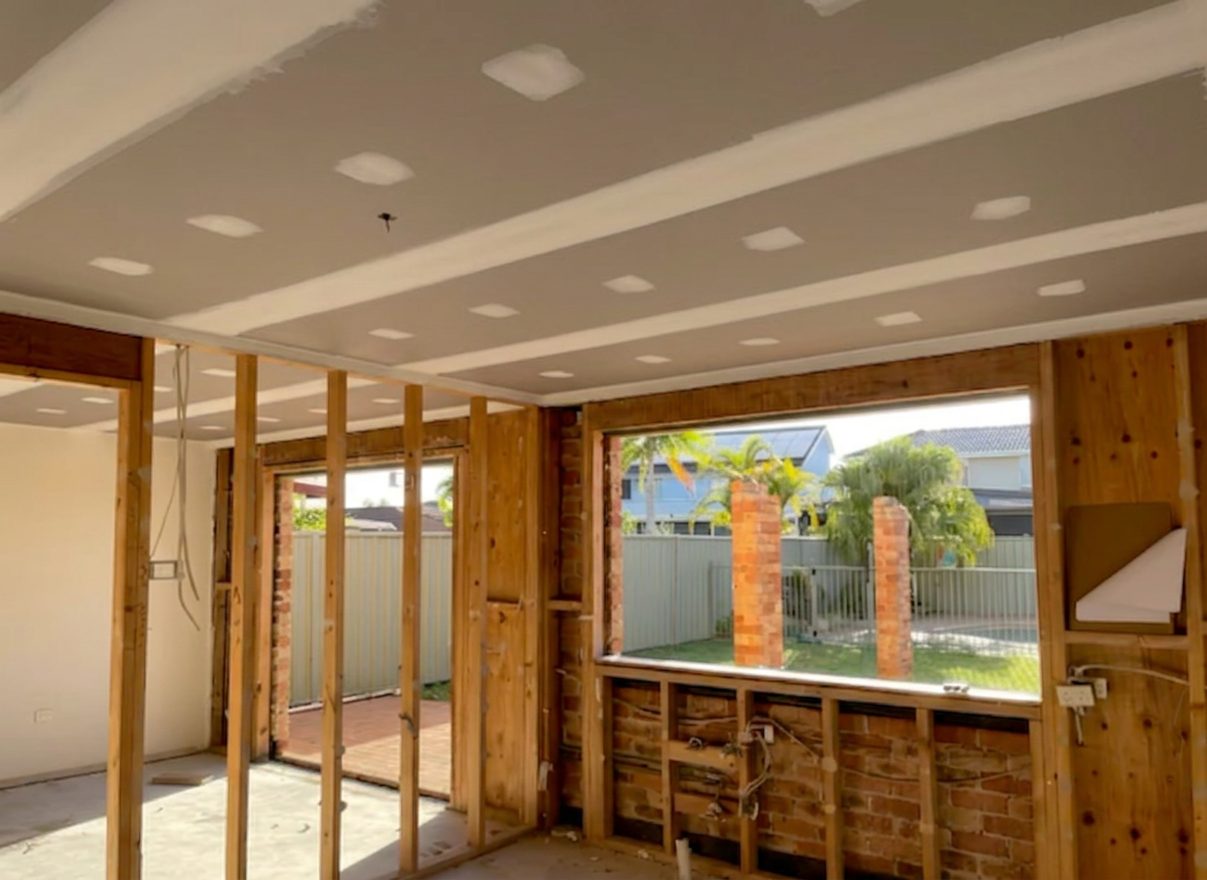
Opening up for open plan
We make good the ceiling, the cornice and the wall junctions where a wall has come out. The ceiling is usually the hard part. Two rooms that were separate have two different ceiling planes, two runs of cornice and often two different linings, and now they are one room. We sheet and set the new work and we bring it into the existing lining at a deliberate joint rather than feathering it in. The wall removal and any structural work are done before we arrive.
- Ceiling and cornice made good across the old opening
- New work brought into old at a deliberate joint
- We sheet and set, we do not remove the wall
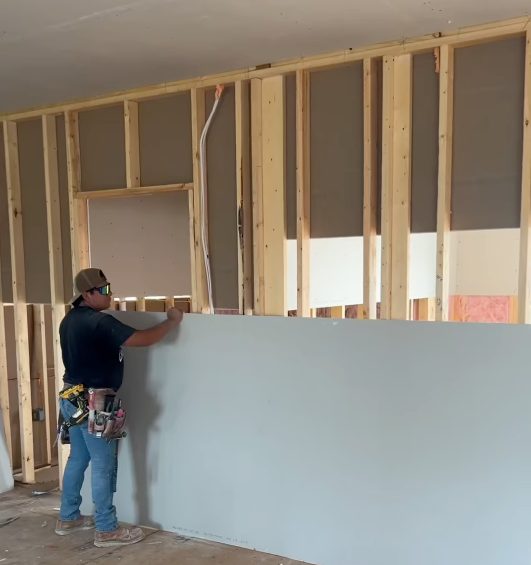
Extensions, additions and pop tops
We sheet the new part and join it to the old. An extension is effectively a small new build attached to a house that has moved for decades. The junction between the two is where the work is. We sheet the addition to a modern specification. Where it meets the original ceiling or wall we put a control joint in rather than trying to make two different structures behave as one.
- New rooms sheeted to a modern specification
- Control joint where new structure meets old
- Level 4 as standard, Level 5 on the new surfaces
What we find in an older Newcastle house
Renovation work in this city runs into things a new build never does, because most of the inner suburbs were built before plasterboard existed here. These are the eight that decide what a job costs and how long it takes. Most of them are visible in a photograph before anyone opens a wall.
It is most likely not plasterboard
CSR brought paper faced plasterboard to Australia in 1947 and it did not become common here until the 1960s. Cooks Hill, Carrington, Islington, Tighes Hill, Mayfield and The Hill are almost all older than that. What is on those walls is lath and plaster, or fibrous plaster made from lime, aggregate, water and animal hair. It is heavier, it is brittle, and it is keyed or wadded rather than screwed. It does not come off or go back the way board does.
Any pre 1990 sheet lining is an asbestos question first
About one in three Australian homes built before 1987 contains asbestos materials. SafeWork NSW rates a pre 1987 house as highly likely and a 1987 to 1990 house as likely. Sheet lining with cover strips in a house of that age gets tested, not cut. We do no asbestos work of any kind. If that is what your walls are, the job stops with us until it has been properly removed by a licensed removalist. We can sheet the room afterwards.
The screw changes because the timber changes
Pre 1960s Newcastle framing is commonly hardwood. Hardwood takes a #6 Type S needle point screw rather than the Type W used on modern pine. A Type W in hardwood strips or snaps, and a snapped screw in a stud is not a fixing you can go back and fix. It is the most common and most expensive mistake made on old houses in this city.
Old and new lining feathered into each other
Where 1930s plaster meets 2026 plasterboard you have two materials of different ages, different thicknesses and different movement meeting at one line. The standard requires a control joint at every change of lining material, and a renovation is the textbook case. Feathering the new sheet into the old surface makes the join disappear on the day and brings it back the first dry summer. A deliberate break is the honest answer.
Sheeting over the top costs 10mm everywhere
Fixing new board over sound existing lining is quick and it is often the right call. What it does is add 10mm at every architrave, skirting, window reveal, door jamb and cornice line in the room. Every one of those has to be packed out or refitted by a carpenter afterwards. It is worth knowing before you choose it, because the plastering is the cheap half of that decision.
Repair joints from 1989 that never stopped moving
The Newcastle earthquake on 28 December 1989 damaged around 50,000 buildings, about 80 percent of them homes. It is still the most damaging earthquake in Australian history. A large share of the older housing here was patched, re rendered or partly re lined in the years after. Open a wall in Hamilton or Merewether and a patchwork of original plaster and 1990s repair work is normal. The repair joints are frequently the cracks that brought you here.
A cornice profile that is not in any catalogue
Modern cove cornice comes in 55mm, 75mm and 90mm. A Federation run cornice, an interwar stepped profile or an ornate ceiling rose is none of those. Matching one means taking a mould off the original and casting it. That is decorative plastering and it is not work we do. If your room has a profile like that and you want it matched, we will tell you early. The alternative is fitting the nearest thing in the catalogue and leaving you to notice once it is all one colour.
Expecting Level 5 over the original plaster
Level 5 is three coats plus a skim over every square metre, and on newly sheeted surfaces we can deliver it. Over seventy year old plaster on a frame that is out of plane, nobody can honestly promise it. New glazing and downlights in a renovated room are exactly the conditions that show a wall up. It is worth deciding early which surfaces are new and which are being kept.
How a renovation job runs
We quote from your photographs
Send photographs of the rooms and we price the work from them. In an older house that photograph is doing real work. It tells us whether we are looking at plasterboard, fibrous plaster or lath and plaster. Those are three different jobs. We will tell you on the phone what we can see.
We bring board that suits the frame we find
In an older house the material list is decided by what is behind the lining rather than by the plan. Joist spacing in a house from the 1930s is rarely 450mm or 600mm or anything else in particular. The board, the cornice, the compounds, the tape and the fixings all come from us.
You can stay in the house
We work room by room and you can keep living in the place while we do. Clear the furniture out of the room before we arrive. If you want to cover anything that has to stay, cloths or drop sheets over it help. We sand with a dust extracted sander, with some hand sanding, so there is dust in the air while we work.
Get a free quote
Send photographs of every room you want done, wide enough to show the whole wall or ceiling rather than close ups of the damage. In an older Newcastle house a photograph tells us what the lining is, and that decides the job. Quoting is free. Quotes are free, including a site visit where one helps, and we do not charge for travel.
Brands we supply and install
Newcastle Gyprocker Heroes supply the board, the cornice, the compounds and the fixings on every job, so there is nothing for you to order and no delivery to wait on. That is worth saying plainly: if you have already bought your own sheets, you are looking for a different arrangement to the one we offer.
Service available across every Newcastle region
City of Newcastle
Newcastle CBD, Newcastle East, The Hill, Cooks Hill, Merewether, Bar Beach, The Junction, Hamilton, Islington, Wickham, Carrington, Tighes Hill, Mayfield, Waratah, Georgetown, Lambton, New Lambton, Adamstown, Broadmeadow, Jesmond, Wallsend, Maryland and Fletcher
Lake Macquarie
Charlestown, Kotara, Warners Bay, Speers Point, Boolaroo, Cardiff, Edgeworth, Glendale, Cameron Park, Belmont, Valentine, Eleebana, Redhead, Dudley, Swansea, Caves Beach, Toronto and Morisset
Maitland and the Hunter Valley
Maitland, East Maitland, Rutherford, Lorn, Bolwarra, Thornton, Beresfield, Chisholm, Gillieston Heights, Lochinvar, Farley, Branxton, Greta, Cessnock, Kurri Kurri, Weston and Singleton
Port Stephens
Raymond Terrace, Heatherbrae, Medowie, Williamtown, Fern Bay, Tomago, Salt Ash, Tanilba Bay, Lemon Tree Passage, Salamander Bay, Corlette, Soldiers Point, Nelson Bay, Shoal Bay and Anna Bay
Central Coast
Gosford, East Gosford, West Gosford, Erina, Woy Woy, Umina Beach, Ettalong Beach, Kincumber, Avoca Beach, Copacabana, MacMasters Beach, Terrigal, Wyoming, Wyong, Tuggerah, Watanobbi, Berkeley Vale, Bateau Bay, Long Jetty, The Entrance, Toukley, Budgewoi, San Remo and Lake Munmorah
Frequently asked questions
Do you strip out the old lining?
No. Newcastle Gyprocker Heroes work to areas that are open and ready to sheet. The removal, the framing and any structural work happen before we arrive. If you need the old lining taken off, your builder or demolition contractor does that part. We can tell you from your photographs what state a room needs to be in before we start.
What does renovation plastering cost?
Renovation work is quoted per job rather than at a set rate per square metre. What is behind the lining decides most of the price. Send photographs of every room you want done and we will give you a figure. The quote is free and no travel charge is added anywhere we work.
Is my 1930s Newcastle house plasterboard?
No, most likely not. Paper faced plasterboard arrived in Australia in 1947 and only became common in the 1960s. A 1930s Newcastle house is more likely lath and plaster or fibrous plaster. Send us photographs and we will tell you which. It changes what the job is, so it is worth knowing before anyone quotes it.
Can I live in the house while you work?
Yes. We work room by room and most renovation jobs are finished in one to two days on site. Clear the furniture out of the room before we arrive, and cover anything that has to stay. There will be dust in the air while we sand, even with a dust extracted sander.
What happens if you find asbestos?
We stop. Newcastle Gyprocker Heroes do no asbestos work of any kind, in any quantity, and nobody can identify asbestos by looking at it. If we suspect it, we leave it undisturbed and tell you, so you can have it tested and removed by a licensed removalist. Once it has been properly removed we can come back and sheet the room.
Will the new plaster match the old?
Yes, on the flat surfaces. Where new sheeting meets old plaster we put in a deliberate joint rather than feathering the two together. They are different materials of different ages and the feathered version reopens. Decorative profiles are the exception: an ornate cornice or a ceiling rose has to be moulded and cast, and that is not work we do.
Can you work in around my builder?
Yes. Newcastle Gyprocker Heroes sheet and set once the area is open and ready. We slot in behind your builder, electrician and plumber rather than holding them up. We usually start within five business days of the quote being accepted, and a renovation runs one to two days on site. Send us your dates and we will tell you whether they work.
Ready to get a price?
Send plans or photographs and we will price the job. Quoting is free and so is the travel.