Cornice installation and repairs in Newcastle
We fit new cornice, run square set and repair single damaged lengths, on jobs through Newcastle, Lake Macquarie, Maitland, Port Stephens and the Central Coast. Cornice is the one part of a plastered room with its own written tolerance in New South Wales, 4mm over 2m. It is the first thing anybody notices when it is out. The profile and the cement come from us. We bed the run to a struck line rather than to the wall, and leave it set and ready for your painter. A single damaged run in one room is a job on its own, quoted from a photograph.
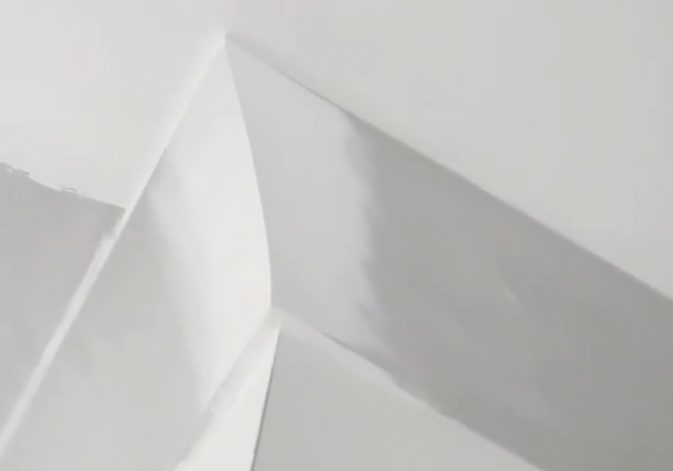
New cornice through a house
We run the cornice through a new build or a renovation as one job, room by room. A line carries around a corner rather than stopping at it. We fit the Gyprock cove profiles at 55mm, 75mm and 90mm, in lengths up to 5400mm. That keeps the number of joins down in a long run. Aria at 75mm is the modern profile we run most where a room wants something slimmer. We pick the cement grade off the length of the run, and the finished line goes to your painter.
- Cove at 55mm, 75mm and 90mm, plus the modern profiles
- Lengths to 5400mm, so fewer joins in a long run
- Mitres cut in a box rather than by eye
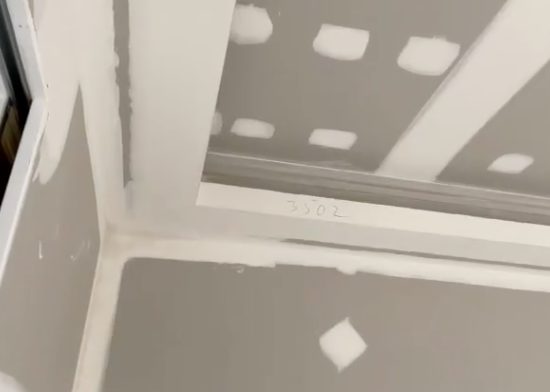
Square set instead of cornice
We run square set where you want the wall to meet the ceiling as a sharp line with no profile on it. It costs the same as a cornice finish with us. The choice is about how you want the room to read rather than about price. What matters is that you say so at frame stage, not at cornice stage. Square set fixes the sheet ends at 150mm centres instead of 300mm and the recessed edge along the wall comes off. It changes the sheeting well before it changes the finish.
- Priced the same as a cornice finish
- Sheet ends at 150mm centres rather than 300mm
- Decided at frame stage, not at cornice stage
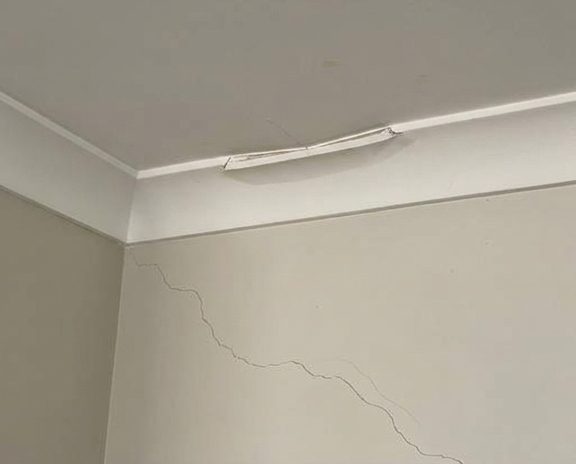
Repairing a damaged run
We cut out the damaged length, mitre and bed a new section into the run, and blend the joint into what is already there. A single run in one room is a job on its own and we quote it from a photograph. Where the cornice has come away from the ceiling rather than been knocked, we look at the ceiling first. Bedding a cornice back under a ceiling that is still moving buys you one season.
- A single damaged run is a job on its own
- Quoted from a photograph, no minimum room count
- We check the ceiling before we bed the line back
What decides a cornice job
Cornice sits on the junction of two planes that move independently. It is the first thing in a room to show when either of them moves. These are the eight things that decide what a cornice job involves, and half of them are settled before anyone picks a profile.
Cornice has its own tolerance, and it is 4mm over 2m
The NSW Guide to Standards and Tolerances sets the number. A plaster cornice is defective if it deviates from a straight line by more than 4mm over a length of up to 2m. The deviation also has to be visible from a normal viewing position. The Guide is explicit that the same 4mm applies over 1m or over 500mm, so the allowance does not shrink with the measurement. No other part of internal lining work carries a number that precise. We run to the struck line rather than to the wall, because that is the only way to hold it.
The cement is the fixing and the nails are not
A 10mm bead of cornice cement goes along the back of each edge, laid on with a broadknife. The length is pushed firmly onto the guideline. A few clouts are tapped in along the top and bottom edges to hold it while the cement goes off. That is all the nails are for. A cornice carried by nails with cement smeared over the gaps is a cornice that drops a section.
The grade of cement is picked by the length of the run
Cornice cement is a setting compound rather than a drying one, so it goes off chemically on a clock instead of waiting for the air. It comes in 45, 60 and 90 minute working lives for exactly that reason. Anything left in the bucket is discarded rather than watered back. Roughly 12kg does 100 lineal metres. Picking the wrong grade for the length of a run is how a continuous line ends up with a stop mark in it.
Internal and external mitres are cut the opposite way round
A cornice mitre is a compound cut and it is made in a mitre box or a Mitremasta rather than by eye. On an internal corner the ceiling edge finishes shorter, and the direction of the cut reverses for the other leg of the angle. On an external angle the wall length is the shorter one. Get it backwards and every corner in the room carries a gap. Mitres are where the time in a cornice job goes, not lineal metres.
The substrate decides the adhesive
Cornice cement is specified for plasterboard and fibre cement. On plaster glass, cement render or any highly absorbent surface the manufacturer recommends masonry adhesive instead. An absorbent substrate pulls the water out of the cement before it has set. That is a constant question in the older Newcastle suburbs, and it is how a run debonds a year after it went up looking perfect.
A cornice pulling off the ceiling is usually not a cornice fault
Cornice bridges two surfaces that move independently, so it shows movement rather than causing it. Four things open the cornice line before they show anywhere else. They are a ceiling sagging on failed adhesive, insulation above the 5kg/m² the span tables assume, and board spanning further than it is rated for. First season frame shrinkage in a new house does the same. We will tell you when the ceiling is the job and the cornice is only the symptom.
A period profile is a casting job and casting is not what we do
Gyprock's Ornamental range is a Victoria only product. There is no New South Wales catalogue equivalent for a Federation run cornice or a ceiling rose. Matching one means taking a mould off a sound length and casting the replacement, which is decorative plastering and not work we do. In the Cooks Hill, Hamilton, The Hill and Newcastle East conservation areas that work can also need a development application with a heritage assessment. We say so early rather than fit the nearest catalogue profile.
Square set has to be decided before the frame goes up
Square set is not the absence of cornice, it is a tighter job. Sheet ends fix at 150mm maximum centres for square set against 300mm with a cornice finish. The board's recessed edge along the wall is best removed. There is no profile left to absorb a wall that is out of line, so the set out has to be right from the start. It costs the same as cornice with us, which means the decision is about the room rather than about money.
How we run cornice
We set the line before we set the cornice
A cornice follows a struck guideline, not the wall behind it. Walls wander, and a cornice run to a wandering wall shows every bend. The eye reads a long straight line far better than it reads a flat surface. We strike the line first and the profile goes to that.
We supply the profile and the cement
The cornice, the cornice cement, the fixings and the finishing compounds all come from us. We fit the Gyprock cove sizes at 55mm, 75mm and 90mm. We also fit the modern profiles, including Aria and Duo, where a room wants something slimmer.
We quote a repair from a photograph
Send a photograph of the damaged run and we price it over the phone. A single run in one room is a job on its own, so there is no minimum of a whole house or a whole room. The quote costs nothing and the travel is not charged.
Get a free quote
For a repair we want two photographs. Take one along the length of the run rather than square on to it, and one of the whole wall to ceiling line. For new work, send your floor plans and tell us the ceiling heights. Quoting is free. Quotes are free, including a site visit where one helps, and we do not charge for travel.
Brands we supply and install
Newcastle Gyprocker Heroes supply the board, the cornice, the compounds and the fixings on every job, so there is nothing for you to order and no delivery to wait on. That is worth saying plainly: if you have already bought your own sheets, you are looking for a different arrangement to the one we offer.
Service available across every Newcastle region
City of Newcastle
Newcastle CBD, Newcastle East, The Hill, Cooks Hill, Merewether, Bar Beach, The Junction, Hamilton, Islington, Wickham, Carrington, Tighes Hill, Mayfield, Waratah, Georgetown, Lambton, New Lambton, Adamstown, Broadmeadow, Jesmond, Wallsend, Maryland and Fletcher
Lake Macquarie
Charlestown, Kotara, Warners Bay, Speers Point, Boolaroo, Cardiff, Edgeworth, Glendale, Cameron Park, Belmont, Valentine, Eleebana, Redhead, Dudley, Swansea, Caves Beach, Toronto and Morisset
Maitland and the Hunter Valley
Maitland, East Maitland, Rutherford, Lorn, Bolwarra, Thornton, Beresfield, Chisholm, Gillieston Heights, Lochinvar, Farley, Branxton, Greta, Cessnock, Kurri Kurri, Weston and Singleton
Port Stephens
Raymond Terrace, Heatherbrae, Medowie, Williamtown, Fern Bay, Tomago, Salt Ash, Tanilba Bay, Lemon Tree Passage, Salamander Bay, Corlette, Soldiers Point, Nelson Bay, Shoal Bay and Anna Bay
Central Coast
Gosford, East Gosford, West Gosford, Erina, Woy Woy, Umina Beach, Ettalong Beach, Kincumber, Avoca Beach, Copacabana, MacMasters Beach, Terrigal, Wyoming, Wyong, Tuggerah, Watanobbi, Berkeley Vale, Bateau Bay, Long Jetty, The Entrance, Toukley, Budgewoi, San Remo and Lake Munmorah
Frequently asked questions
What does new cornice cost?
Cornice is quoted per job rather than at a rate per metre. The profile, the number of mitres and the ceiling height move the figure more than the length of the run does. Send photographs or your floor plans and Newcastle Gyprocker Heroes will price the actual rooms. Quotes are free, and no travel charge is added anywhere across the Hunter or the Central Coast.
Do you do square set?
Yes. Newcastle Gyprocker Heroes run square set and it costs the same as a cornice finish. The choice is about how the room reads rather than about price. Tell us at frame stage rather than at cornice stage. Square set fixes the sheet ends at 150mm centres instead of 300mm and leaves no profile to absorb a junction that is out of line.
Will you replace a single damaged run of cornice?
Yes. A single damaged run in one room is a job on its own with Newcastle Gyprocker Heroes. There is no minimum of a whole room or a whole house. Send a photograph taken along the length of the run rather than square on to it. We cut out the damaged length, bed a new section in and blend the joint into the existing run.
Which cornice profiles do you fit?
The Gyprock cove sizes at 55mm, 75mm and 90mm, and the modern profiles including Aria and Duo. Cove is the classic and it suits most Hunter housing. A smaller profile can make a room with a lower ceiling read as taller. That is worth knowing before you default to the largest one in the catalogue.
Can you match the ornate cornice in my old house?
No. There is no New South Wales catalogue equivalent, because the Ornamental range is sold in Victoria only. So a Federation run cornice or a ceiling rose has to be moulded off a sound length and cast. That is decorative plastering rather than work Newcastle Gyprocker Heroes take on. We tell you early rather than fit the nearest catalogue profile and leave you to notice once the room is one colour.
Why does my cornice keep cracking at the ceiling?
The ceiling is usually the cause rather than the cornice. Cornice bridges two surfaces that move independently. That is why it is the first place a moving ceiling shows, whatever is moving it. Send a photograph and we will tell you whether you have a cornice job or a ceiling job.
What is the difference between cornice and square set?
Cornice is a moulded profile bedded into the join between the wall and the ceiling. Square set leaves that join as a sharp line with nothing on it. Cornice hides a small amount of movement and a junction that is not perfectly true. Square set hides none of it, which is why square set is set out at frame stage rather than chosen at the end.
Ready to get a price?
Send plans or photographs and we will price the job. Quoting is free and so is the travel.