Bulkhead ceiling lining in Newcastle
We line bulkhead ceilings across Newcastle, Lake Macquarie, Maitland, Port Stephens and the Central Coast, from $550 for a 3m x 1m bulkhead. That figure is lining only, which is a description of the whole job rather than a caveat. Your builder or ceiling fixer frames the steel or timber box. We sheet and set it. The corner is what a bulkhead is judged on and the corner is a plastering job rather than a framing one.
Kitchen and laundry bulkheads
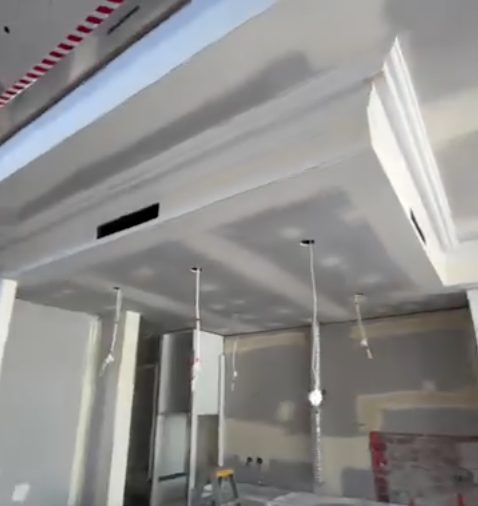
We sheet the bulkheads that sit above overhead cabinetry and hide rangehood and exhaust ducting, which are a standard inclusion across the Hunter estates. These are usually short runs with several external corners in a small space. The corner work is most of the job and the setout has to agree with the cabinetry rather than with the wall. Send the cabinetry drawings with the bulkhead detail and we will price the two together.
- Set out to the cabinetry, not to the wall
- Several corners in a short run, priced accordingly
- From $550 for a 3m x 1m bulkhead, lining only
Boxing in ducting and beams in an older house
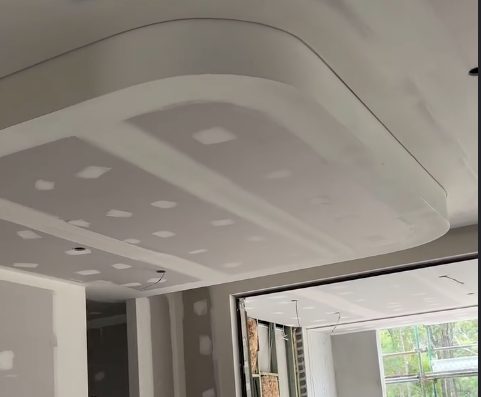
We line the bulkheads that carry ducted air conditioning into an inner Newcastle house. We also line the ones that box in a beam after a wall comes out. The older stock has no service cavity and no riser. It also has ceilings well above the 2.4m minimum, which is the room that makes a bulkhead work without making the room feel low. The framing is your builder's and we sheet and set it.
- The answer where there is no service cavity
- High ceilings give the drop somewhere to go
- Beams boxed in after a wall removal
Feature bulkheads with a light trough or shadow gap
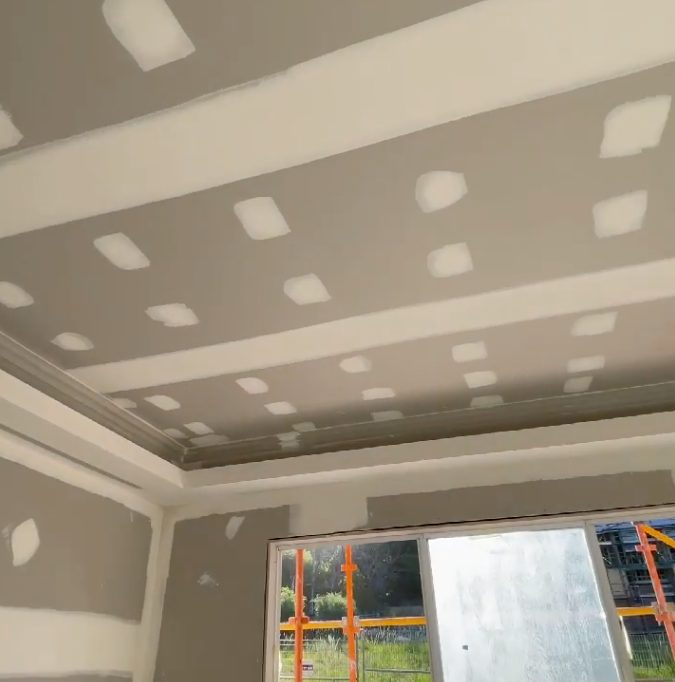
We sheet and set the bulkheads that carry indirect lighting. That is the highest visibility version of this work and the one worth talking about early. The trim goes in before the set rather than after it, and the level of finish is a real decision rather than a default. The strip will wash that face at a grazing angle for the life of the room. We will tell you plainly what a finish can and cannot do under that light.
- Shadow gap and trough trims set before the coats
- Level of finish decided at design stage
- Honest about what any finish does under grazing light
What decides a bulkhead
A bulkhead exists to hide something, and what is inside it decides its size before anybody talks about how it looks. These are the eight things that settle the job, and half of them are framing decisions we do not make but do have to sheet.
There is a published maximum drop and it is 1200mm
Rondo's own system limit is that a bulkhead drop is not to exceed 1200mm unless it is appropriately designed otherwise. There is a second threshold before it: past about 600mm, furring channel becomes difficult and the framing moves to steel studs. Those two numbers decide how the box gets built before anything else is discussed. Where a bulkhead is going deeper or carrying a heavy lining, it needs designing rather than improvising.
A bulkhead hangs off the building, not off your ceiling
Bulkheads require independent suspension to carry the extra layers of plasterboard and framing. A bulkhead hung from the main ceiling grid is loading a system that was designed to carry a flat lining and nothing else. It reports the problem at the corner within a year or two. It is the single most common reason a bulkhead cracks where the face meets the soffit. We will say if we see it before we sheet.
Heavy lining has to be braced off the structure
Where a bulkhead is lined with heavy materials the supporting framing has to be braced off the building structure. Furring channel on its own cannot carry it. Rondo's own advice where there is no structural engineer on the job is to contact them for design assistance. That is a framing question rather than a lining one. The weight going onto it is the board, so it is worth settling before anybody orders sheets.
The corner is the product
Nobody assesses a bulkhead by its area. They look at the external corner and whether it runs true. The bulkhead framing systems exist specifically to deliver a true corner, using concealed support clips so there is nothing in the angle to work around. From our side it is a metal bead, a face set to a line rather than to whatever the framing did. A corner tool worked through the set rather than filled and sanded flat.
A bulkhead with a light in it is a Level 5 problem by design
A light trough is a bulkhead with a rebate along the top edge holding an LED strip out of sight. A shadow gap does the same across the face. Either way the bulkhead is permanently lit at a grazing angle, which is exactly the critical lighting condition Level 5 exists for. CSR says plainly that no finish level, Level 5 included, is expected to clear every glancing light problem. We would rather have that conversation at design stage than after the strip is switched on.
Curves are ordered, not bent on site
Top cross rails can be ordered in custom radiuses, which is a lead time item settled at design stage. On our side, flexible board has published minimum radii: 450mm concave installed vertically and 650mm horizontally, 250mm convex vertically and 450mm horizontally. Low temperature and low humidity both reduce how far the sheet will go. A curve tighter than the board allows is a different detail rather than a harder day.
A control joint that crosses a bulkhead is carried through it
Control joints are required at every change of lining material and aligned with the structure's own joints. Newcastle sits across several Mine Subsidence Districts where buildings are designed to articulate. A joint line reaching a bulkhead is not something to sheet over and hope about. Where a joint runs into a bulkhead, it goes through the bulkhead rather than stopping at it.
The services inside it have to be finished first
A bulkhead exists to conceal ducting, pipework, wiring or a beam, and once it is lined none of that is reachable without opening it again. Ducted air routes change, rangehoods move and a sparky comes back. Everything inside is installed and signed off before we sheet. Where something in there will need reaching later, the access is set out with the framing rather than cut into a finished face.
How we line a bulkhead
We work to the corner, not the square metres
A bulkhead is assessed on whether the external corner is straight over its full length and square in both planes. Metal bead in the angle, the face run to a line rather than to the framing, and a corner tool through the set. That is where the time in a bulkhead goes and it is what you look at every day.
We sheet the soffit and the face
Board grade follows the framing centres, so 10mm Gyprock Plus to 450mm and 10mm Supaceil or 13mm Standard to 600mm. Where the bulkhead is part of a fire rated or acoustic assembly we put back the board that system names. There is no substitution and no adhesive anywhere in it.
We do not frame the box
The steel or timber framing, the suspension and the bracing are your builder's or ceiling fixer's work. We arrive once the box is framed, braced and true. If the face is not straight before we sheet it, no amount of setting makes it straight afterwards. We will tell you rather than sheet it and hope.
Get a free quote
Send a photograph of the framed box, or the drawings if it is not up yet. Tell us the length, the drop and how many external corners there are. Say whether there is a light strip or a shadow gap in it, because that changes the finish. Quotes are free and we add nothing for travel anywhere we work. Quotes are free, including a site visit where one helps, and we do not charge for travel.
Brands we supply and install
Newcastle Gyprocker Heroes supply the board, the cornice, the compounds and the fixings on every job, so there is nothing for you to order and no delivery to wait on. That is worth saying plainly: if you have already bought your own sheets, you are looking for a different arrangement to the one we offer.
Service available across every Newcastle region
City of Newcastle
Newcastle CBD, Newcastle East, The Hill, Cooks Hill, Merewether, Bar Beach, The Junction, Hamilton, Islington, Wickham, Carrington, Tighes Hill, Mayfield, Waratah, Georgetown, Lambton, New Lambton, Adamstown, Broadmeadow, Jesmond, Wallsend, Maryland and Fletcher
Lake Macquarie
Charlestown, Kotara, Warners Bay, Speers Point, Boolaroo, Cardiff, Edgeworth, Glendale, Cameron Park, Belmont, Valentine, Eleebana, Redhead, Dudley, Swansea, Caves Beach, Toronto and Morisset
Maitland and the Hunter Valley
Maitland, East Maitland, Rutherford, Lorn, Bolwarra, Thornton, Beresfield, Chisholm, Gillieston Heights, Lochinvar, Farley, Branxton, Greta, Cessnock, Kurri Kurri, Weston and Singleton
Port Stephens
Raymond Terrace, Heatherbrae, Medowie, Williamtown, Fern Bay, Tomago, Salt Ash, Tanilba Bay, Lemon Tree Passage, Salamander Bay, Corlette, Soldiers Point, Nelson Bay, Shoal Bay and Anna Bay
Central Coast
Gosford, East Gosford, West Gosford, Erina, Woy Woy, Umina Beach, Ettalong Beach, Kincumber, Avoca Beach, Copacabana, MacMasters Beach, Terrigal, Wyoming, Wyong, Tuggerah, Watanobbi, Berkeley Vale, Bateau Bay, Long Jetty, The Entrance, Toukley, Budgewoi, San Remo and Lake Munmorah
Frequently asked questions
How much does a bulkhead cost?
Newcastle Gyprocker Heroes price a 3m x 1m bulkhead from $550, lining only. That covers sheeting, setting and finishing the box once it is framed, and the framing itself is your builder's or ceiling fixer's work. The figure moves with the length, the number of external corners and the level of finish. Send a photograph or the drawing and we will price the actual bulkhead.
Do you frame the bulkhead as well?
No. The box, its bracing and the suspension it hangs from are your builder's or ceiling fixer's work, steel studs and furring channel included. Newcastle Gyprocker Heroes come in once it is framed, braced and true. If the face is not straight before it is sheeted, no amount of setting will make it straight afterwards.
How deep can a bulkhead be?
The published system maximum is a 1200mm drop unless it is appropriately designed otherwise. There is a second threshold well before that. Past about 600mm the framing usually moves from furring channel to steel studs, because the channel gets difficult at that depth. Both are framing decisions, and both change what we are sheeting, so they are worth settling early.
Why has my bulkhead cracked at the corner?
The most common cause is a bulkhead hung off the main ceiling grid rather than off the building structure. Bulkheads need independent suspension to carry the extra board and framing. A grid designed for a flat lining will report the extra load at the corner within a year or two. Send photographs along the length of the corner and we will tell you what it looks like from here.
Can you do a curved bulkhead?
Yes, where the framing has been set up for the curve. Top cross rails are ordered in custom radiuses at design stage rather than bent on site. Flexible board then has its own published limits: 450mm minimum radius concave installed vertically and 650mm horizontally, and 250mm convex vertically and 450mm horizontally. Cold or dry conditions reduce how far it will go.
Does a bulkhead with an LED strip need a Level 5 finish?
Yes, it is worth specifying one, and it is worth deciding before the framing goes up. A light trough or shadow gap washes the bulkhead face at a grazing angle permanently, which is the critical lighting condition Level 5 exists for. CSR's own caveat applies, so a Level 5 improves the odds rather than guaranteeing a face with nothing in it.
Can you box in the ducting for my new air conditioning?
Yes, once the ducting is in and the box is framed. Newcastle Gyprocker Heroes sheet and set the bulkhead, and the ducting and the framing are your air conditioning installer's and your builder's work. Everything inside a bulkhead has to be finished and signed off first. Once it is lined nothing in there is reachable without opening it again.
Ready to get a price?
Send plans or photographs and we will price the job. Quoting is free and so is the travel.